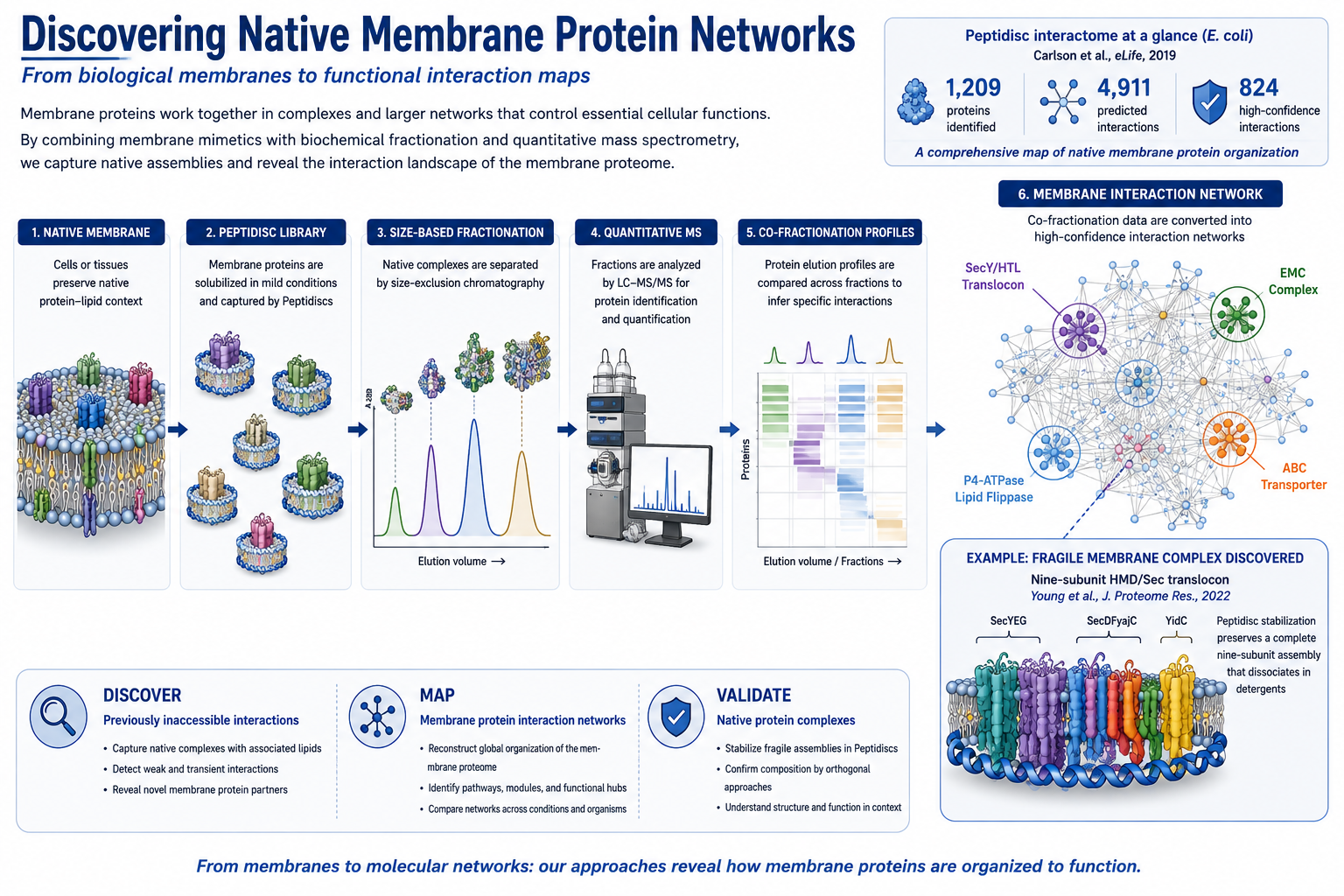
Membrane proteins rarely function in isolation. They assemble into complexes and larger molecular networks that control transport, signaling, metabolism, and many other cellular processes. Yet these interactions can be difficult to detect because membrane disruption and prolonged exposure to detergents can cause fragile protein assemblies to dissociate. By combining membrane mimetics with biochemical fractionation, affinity purification, and quantitative mass spectrometry, we can capture membrane protein complexes and identify their interaction partners directly from biological membranes. Our early Peptidisc interactome studies demonstrated that thousands of membrane protein interactions could be reconstructed from native membrane preparations. These approaches have since allowed us to discover and stabilize fragile membrane assemblies that are difficult to observe using conventional detergent-based methods. Together, this provides a way to move beyond studying individual membrane proteins toward understanding how they are organized into functional molecular networks.
KEY PUBLICATIONS
Profiling the Escherichia coli membrane protein interactome captured in Peptidisc libraries.
Carlson ML, Stacey RG, Young JW, Wason IS, Zhao Z, Rattray DG, Scott N, Kerr CH, Babu M, Foster LJ, Duong Van Hoa F. eLife. 2019;8:e46615. doi:10.7554/eLife.46615.Development of a Method Combining Peptidiscs and Proteomics to Identify, Stabilize, and Purify a Detergent-Sensitive Membrane Protein Assembly.
Young JW, Wason IS, Zhao Z, Kim S, Aoki H, Phanse S, Rattray DG, Foster LJ, Babu M, Duong van Hoa F. J Proteome Res. 2022;21(7):1748–1758. doi:10.1021/acs.jproteome.2c00129.Antony F, Bhattacharya A, Aoki H, Babu M, Duong van Hoa F. A detergent-free workflow for native membrane proteomics using Peptergents. bioRxiv. 2026.08.12.744532. doi:10.64898/2026.08.12.744532. Preprint.