Membrane Protein Regulation and Ligand Interactions
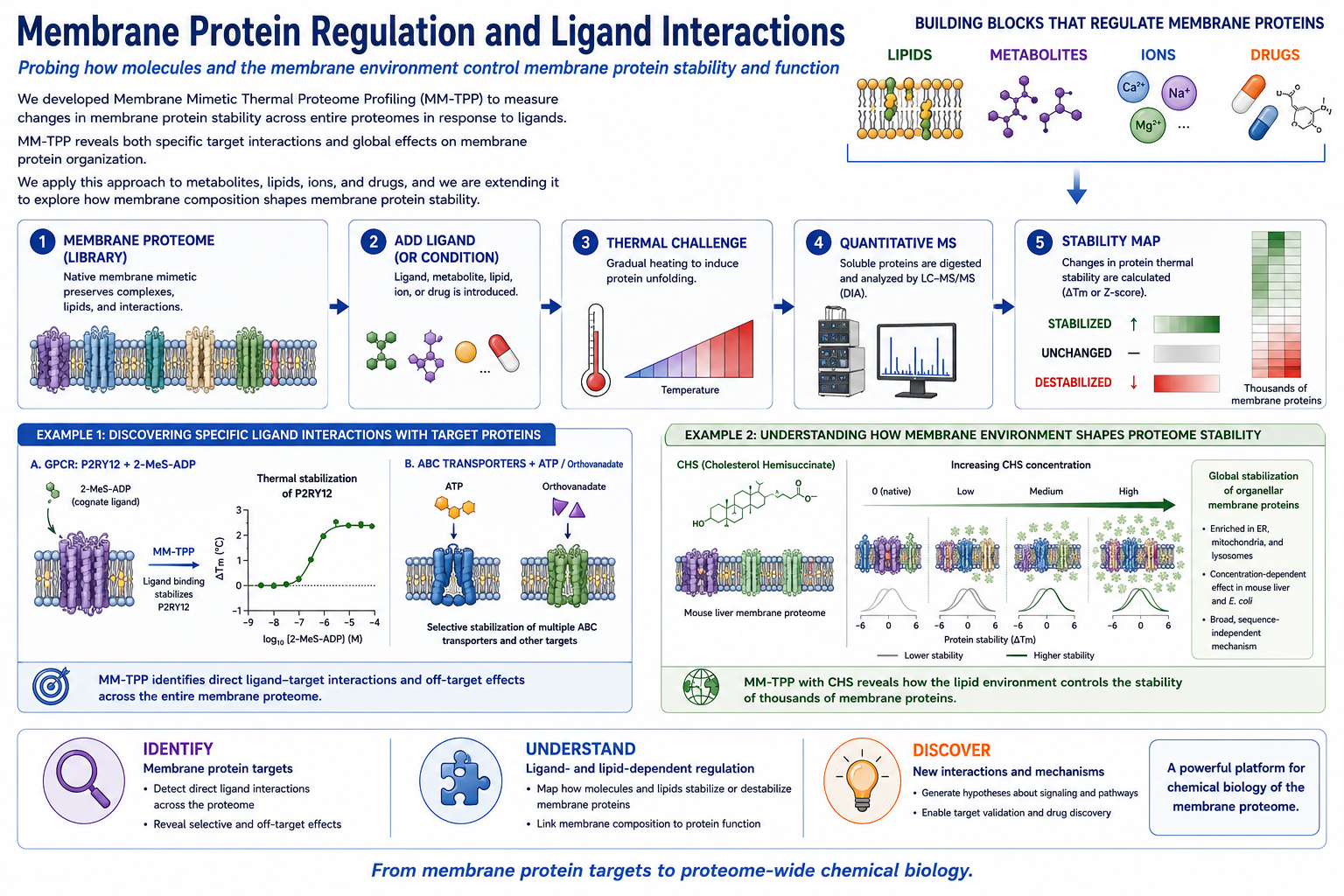
Membrane proteins constantly interact with lipids, metabolites, ions, and small molecules that can alter their stability, conformation, and function. Understanding these interactions is important both for fundamental membrane biology and for discovering how drugs act on membrane protein targets. We developed Membrane Mimetic Thermal Proteome Profiling (MM-TPP) to investigate these interactions across entire membrane proteomes. By measuring changes in protein stability following exposure to a ligand, MM-TPP can reveal both specific target interactions and broader effects on membrane protein organization. We are using this approach to study interactions with metabolites, lipids, and pharmacologically active compounds, moving from individual membrane protein–ligand pairs toward proteome-wide maps of membrane protein regulation. More recently, we have extended MM-TPP to investigate how the lipid environment itself shapes membrane protein stability, providing a new way to explore the relationship between membrane composition and protein function.
KEY PUBLICATIONS
Capture of endogenous lipids in peptidiscs and effect on protein stability and activity.
Jandu RS, Yu H, Zhao Z, Le HT, Kim S, Huan T, Duong van Hoa F.
iScience. 2024;27(4):109382. doi:10.1016/j.isci.2024.109382.Membrane-mimetic thermal proteome profiling (MM-TPP) toward mapping membrane protein-ligand dynamic interactions.
Jandu RS, Bhattacharya A, Antony F, Al-Seragi M, Aoki H, Babu M, Duong van Hoa F.
eLife. 2025;14:RP104549. doi:10.7554/eLife.104549.Membrane Mimetic-Thermal Proteome Profiling Reveals Broad, Sequence-Independent Membrane Protein Stabilization by Cholesteryl Hemisuccinate.
Bhattacharya A, Clunie S, Antony F, Chen Y, Aoki H, Babu M, Duong van Hoa F.
bioRxiv. 2026.08.17.745344. doi:10.64898/2026.08.17.745344. Preprint.